
Executive security services work best as a corporate program with clear ownership, documented handoffs, and the right specialist assigned to each responsibility. A company may need a licensed security provider for protection-related work while also using a premium travel and hospitality partner for accommodations, transportation, event access, and guest experience. Those roles should be coordinated, not confused.
Discuss your corporate event and executive travel requirements with Superior Executive Services
What Does an Executive Security Services Program Include?
A corporate executive security services program is an operating model for protecting people, information, schedules, and business continuity while leaders travel or attend high-profile events. It defines the internal decision makers, the licensed security provider’s scope, and the separate travel, access, logistics, and hospitality responsibilities that keep the experience organized.
The phrase can describe different arrangements. Some organizations need a formal executive protection program. Others need a corporate travel risk process, a dedicated event plan, or a coordinated model for leadership travel and client entertainment. The right scope depends on the principal, destination, itinerary, visibility, business purpose, and risk profile.
That is why a useful program begins with responsibility rather than a package name. A buyer should be able to answer five questions before planning begins:
- Who owns the business objective and final approvals?
- Which work requires a licensed security provider?
- Who coordinates travel, accommodations, transportation, and event access?
- Who can approve an itinerary change or change in guest experience?
- How will the parties communicate without creating duplicate instructions?
The goal is not to make every partner perform every task. The goal is to make each handoff visible so a corporate team can deliver a high-value experience without leaving a gap between security planning and travel execution.
Who Owns Each Part of the Program?
A well-structured corporate program separates three kinds of ownership: internal corporate decisions, licensed protective services, and travel or hospitality execution. The company sets objectives and approvals, a qualified security provider owns security-specific duties, and a travel partner manages the guest journey around the assignment. The written scope should show where those responsibilities meet.
| Program role | Primary responsibility | Questions to document |
|---|---|---|
| Corporate owner | Business objective, guest profile, approvals, sensitive information, and escalation decisions | What must the experience achieve, and who has authority to approve changes? |
| Licensed security provider | Security-specific assessment, protective intelligence, qualified protective personnel, and protection-related procedures | What work is within the provider’s licensed scope for each jurisdiction? |
| Travel and hospitality partner | Accommodations, transportation coordination, event access, hospitality, itinerary details, and guest support | Who owns each booking, credential, transfer, arrival window, and guest request? |
| Venue or local partners | Venue access rules, hospitality operations, arrival procedures, and local event requirements | What does the venue require, and how are updates distributed? |
The corporate owner sets the purpose
The internal owner may sit in corporate security, the executive office, travel, legal, human resources, or event marketing. That person does not need to perform every operational task. The owner does need to define the purpose of the trip, the people involved, the information that must stay private, the approval path, and the result the company expects.
For a client event, the objective may be relationship development and a premium guest experience. For an incentive trip, it may be recognition and retention. For a board or leadership gathering, the objective may include time together, discretion, and a well-managed schedule. Stating the purpose prevents the program from becoming a list of disconnected bookings.
The licensed security provider owns security-specific work
Where a company faces a physical-security concern, the corporate buyer should engage a qualified provider whose personnel, insurance, licensing, and operating authority match the assignment and location. Security-specific work may include protective intelligence, threat assessment, advance work, qualified protective personnel, and protection-related escalation. Those services must be represented accurately and kept separate from hospitality coordination.
Superior Executive Services does not provide licensed protective or bodyguard services. A company that needs that capability should select and contract with an appropriate security provider directly. The travel and hospitality partner can then coordinate with the approved security team on the parts of the itinerary and event experience that belong to travel and access.
The travel and hospitality partner owns the guest journey
A premium travel partner may coordinate accommodations, ground transportation, event tickets, VIP hospitality, access credentials, travel documents, itinerary timing, dining, and on-site guest support. These details affect whether the experience works for a leadership team, but they do not replace licensed security work.
Clear role separation improves accountability. The security provider does not need to manage every dinner reservation, and the travel partner should not make promises about protective services that it is not licensed to deliver.
How Should a Corporate Program Work Before Travel or an Event?
Before a leadership trip or corporate event, the program should move from business objective to approved scope, then from approved scope to a coordinated operating plan. The team should identify decision owners, align the licensed security provider and travel partner, confirm venue requirements, document communications, and brief the people who will manage the experience day to day.
- Define the objective: Identify whether the experience is for client entertainment, an incentive program, a board gathering, a leadership retreat, or another corporate purpose. Record what a successful experience should accomplish.
- Identify the people and itinerary: List the principal, guests, executives, hosts, destinations, venues, arrival windows, and key meetings. Limit sensitive details to the people who need them.
- Confirm the security scope: If protection-related services are needed, document the licensed provider’s responsibilities, jurisdiction, personnel, communication process, and escalation path. Do not treat travel support as a substitute for that scope.
- Build the travel and access plan: Assign owners for accommodations, ground transportation, event tickets, hospitality, access credentials, venue contacts, dining, and schedule coordination.
- Set the handoff rules: Decide who receives itinerary changes, who can approve them, who communicates with the venue, and how the security provider is notified when a change affects the assignment.
- Brief the operating team: Give each team the information needed for its role. A concise shared brief can reduce duplicate questions while preserving sensitive security information.
This process is especially useful when several stakeholders are involved. A corporate buyer may have an executive assistant managing calendar details, a security leader managing protective requirements, a marketing or sales leader hosting clients, and a travel partner coordinating the experience. One documented operating picture helps those groups work together without merging their responsibilities.
What Happens During Arrival, Hospitality, and Event Operations?
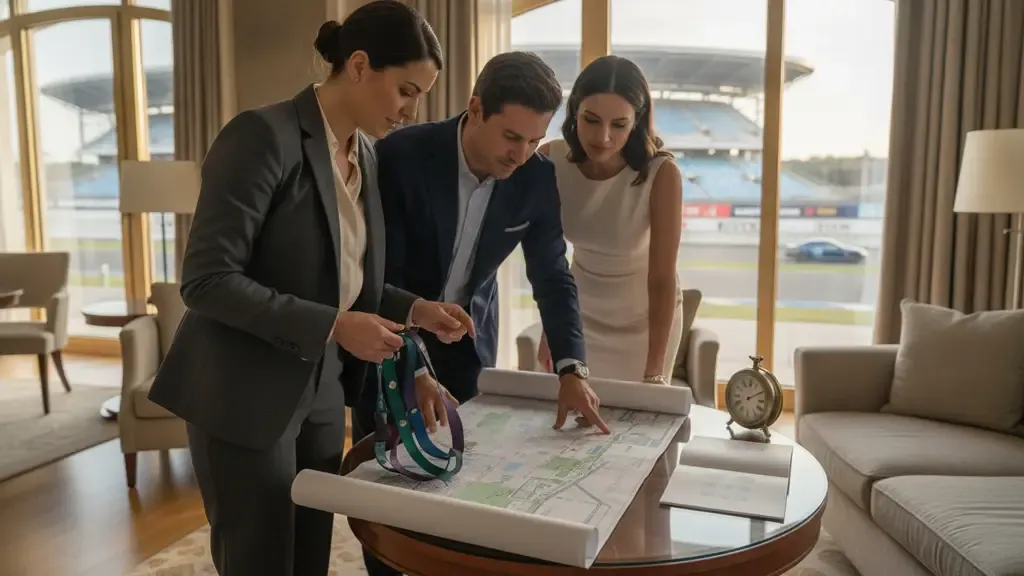
During event operations, the corporate program should make each transition predictable: arrival, hotel check-in, transportation, venue entry, hospitality, scheduled meetings, and departure. The travel team manages the guest experience and logistics within its scope, while the licensed security provider manages protection-related decisions. Both teams need a defined way to share relevant itinerary changes.
Arrival and transportation
The first operational test is often the transition from airport or private arrival point to hotel, meeting, or venue. The travel team should confirm the vehicle plan, pickup timing, guest list, luggage needs, driver contact, route timing, and contingency for delays. If a security provider has a transportation requirement, that requirement belongs in the approved security plan and should be coordinated with the travel team.
For corporate guests, the details are part of the impression. An executive host should not be left to reconcile different pickup instructions while also welcoming clients. One designated logistics contact should own the current itinerary and make sure changes reach the right people.
Venue entry and hospitality
High-profile venues may have different entrances, credential types, hospitality windows, dress expectations, and movement rules. The travel and event team can prepare guests for what to expect, coordinate access information, and manage the hospitality schedule. The venue remains the authority for its entry rules, while the security provider remains responsible for the security work in its own scope.
Superior Executive Services creates premium experiences at events such as Formula 1 races, golf tournaments, and the Kentucky Derby. Its Formula 1 travel experiences include access and hospitality options, accommodations, and concierge planning. Its VIP golf travel packages support corporate hosts and executives with lodging, hospitality, transfers, and on-site coordination.
Itinerary changes
Event plans change. A meeting runs late, weather affects a schedule, a guest arrives at a different time, or the venue changes an access procedure. The program should specify who can change the itinerary, who must be consulted, and who communicates the final version. Not every adjustment is a security event, but a change that affects a principal’s movement or exposure should be routed to the appropriate security contact.
This is where a shared handoff model creates value. The travel team can solve a reservation or access issue quickly without assuming security authority. The security provider can evaluate a protection-related change without having to manage the entire hospitality program.
How Do Security and Travel Partners Hand Off Responsibility?
Security and travel partners should hand off responsibility at defined points instead of relying on informal updates. The corporate owner establishes the decision path, the security provider communicates security requirements and changes, and the travel partner converts approved requirements into an accurate itinerary, access plan, and guest experience.
| Phase | Corporate owner | Security provider | Travel and hospitality partner |
|---|---|---|---|
| Planning | Approves objective, guests, budget, and stakeholders | Defines security-specific scope and requirements | Builds travel, access, accommodations, and hospitality options |
| Pre-arrival | Confirms the final guest and schedule brief | Reviews relevant changes within its assignment | Confirms transfers, rooms, tickets, credentials, and contacts |
| Event day | Receives decisions that require business approval | Manages protection-related decisions and escalation | Manages guest movement within the itinerary, hospitality, and logistics |
| Change control | Approves material changes when required | Assesses changes that affect security scope | Updates reservations, access, transportation, and guest communications |
| Post-event | Reviews business outcome and future needs | Completes its security debrief if applicable | Captures service feedback and improves the next experience |
A useful handoff is specific enough that a new team member can follow it. It should name the primary and backup contacts, state which channel carries time-sensitive updates, describe what requires approval, and identify the version of the itinerary everyone is using. It should also say what each party does not own.
Request a tailored travel and hospitality conversation for your next corporate leadership experience
What Should Be Documented Before Guests Arrive?
The pre-event brief should document the purpose, people, itinerary, responsibilities, contacts, access details, and change process. It should be detailed enough to support smooth execution but limited to the information each team needs. Security-sensitive material should remain with the authorized security and corporate stakeholders rather than being copied into a general hospitality brief.
- Purpose and success measure: State whether the event supports client relationships, employee recognition, leadership connection, or another business goal.
- Guest and host list: Confirm names, roles, arrival needs, dietary requirements, accessibility considerations, and the person who can approve guest changes.
- Itinerary: Include flights or arrival windows, hotels, transfers, venue times, hospitality commitments, dining, meetings, and departure details.
- Access plan: Confirm ticket types, hospitality locations, credential pickup, venue contacts, entry instructions, and any deadlines.
- Responsibility matrix: Name the owner for security-specific work, travel, transportation, access, guest communication, and business approvals.
- Change protocol: Explain which changes are routine, which require approval, and which must be shared with the licensed security provider.
- Communication tree: List primary and backup contacts without distributing sensitive security information beyond the authorized group.
- Post-event review: Reserve time to capture what worked, what changed, and what should be carried into the next program.
Documentation is not about creating paperwork for its own sake. It gives the corporate buyer a way to compare proposals, brief hosts, protect guest privacy, and identify a missing owner before the event begins.
Which Corporate Use Cases Benefit From This Model?
The shared program model is useful whenever a corporate experience combines high-value guests, complex travel, premium access, and multiple decision makers. Common examples include client entertainment, board and leadership gatherings, incentive travel, and executive retreats built around a major sporting or entertainment event.
Client entertainment
Client events need more than impressive tickets. The host must understand the guest list, the business relationship, the schedule, the hospitality setting, and the level of support expected. A role-based program lets the internal host focus on the relationship while specialist partners handle their assigned work. Superior’s corporate group travel guide provides a related planning path for VIP event experiences.
Board and leadership gatherings
Board and leadership events often combine a tight schedule with a high expectation of discretion and comfort. The corporate owner can set the objective and approval process, a licensed provider can manage any protection-specific scope, and a travel partner can coordinate the setting, access, transportation, and hospitality that help the group stay focused.
Incentive travel
Incentive programs should feel rewarding rather than operationally complicated. Guest communications, rooming, transfers, event access, and on-site support all shape the experience. A specialist such as Superior Executive Services can help a company build a premium itinerary around a major event while the company’s security and leadership teams retain their own responsibilities.
Executive retreats at major events
A retreat built around the Kentucky Derby, The Masters, or a Formula 1 weekend may include private accommodations, hospitality, transportation, client meetings, and time for the leadership team to connect. A clear handoff plan helps the company keep the experience polished without asking a travel partner to act as a security provider.
Where Does Superior Executive Services Fit?
Superior Executive Services is the travel, access, logistics, and hospitality partner in this model. The company helps corporate hosts and executives coordinate premium accommodations, ground transportation, event access, VIP hospitality, itinerary details, and on-site guest support. Superior Executive Services does not provide licensed protective or bodyguard services.
That boundary is central to an accurate corporate program. Superior Executive Services can coordinate the travel and event experience around an approved security plan, but it does not claim to conduct threat assessments, provide protective personnel, or deliver licensed security operations. Companies that need those services should engage the appropriate licensed provider.
Within its own scope, Superior Executive Services can help manage the details that often make premium corporate experiences difficult to execute:
- Luxury accommodations and private housing options
- Ground transportation coordination and arrival timing
- Event tickets, hospitality access, and venue credentials
- Customized itineraries for corporate hosts and guests
- Dining, local experiences, and concierge support
- Dedicated communication from planning through the event period
- Flexible coordination when guest or schedule needs change
The concierge travel services team works with executive trips, corporate retreats, VIP events, and incentive travel. For a company planning a premium event, the right first step is a conversation about the group, destination, timing, access requirements, and the responsibilities that should remain with a separate security provider.
How Can Corporate Buyers Evaluate Program Fit?
Corporate buyers can evaluate program fit by asking whether the proposed model matches the business objective, guest profile, location, access requirements, and approval process. The best proposal makes scope visible. It identifies what the licensed security provider owns, what the travel partner owns, what the company must approve, and how changes move between them.
Useful questions include:
- What outcome is the experience meant to support? A client relationship event, incentive program, board gathering, and private executive trip may need different planning choices.
- Which responsibilities require a separate licensed provider? Keep security-specific work distinct from travel and hospitality services.
- Who owns the current itinerary? One person or team should maintain the accurate version and distribute approved changes.
- How will access be managed? Confirm ticket types, hospitality locations, credentials, venue deadlines, and guest instructions.
- What happens when plans change? Identify routine adjustments, approval thresholds, and the handoff for changes affecting security scope.
- Who supports the guests during the event? Define the travel, hospitality, and concierge contacts so the corporate host is not forced to solve every issue.
- What will be reviewed afterward? A short debrief can improve the next event and support a longer-term relationship with the right partners.
These questions help a company compare a security proposal and a travel proposal without treating them as interchangeable. They also create a cleaner path for procurement, legal review, executive approval, and guest communications.
Frequently Asked Questions
What are executive security services for a corporate program?
Executive security services may refer to a coordinated corporate program that addresses leadership travel, physical security, information handling, and business continuity. The security portion should be handled by a qualified licensed provider. A separate travel and hospitality partner may coordinate accommodations, transportation, event access, and guest experience without replacing protective services.
Does Superior Executive Services provide executive protection or bodyguards?
No. Superior Executive Services is a luxury travel and hospitality company, not a licensed protective or bodyguard services provider. Its role is to coordinate premium travel, accommodations, transportation, event access, hospitality, itineraries, and guest support. A company that needs protective services should contract with an appropriately qualified provider.
Can a travel partner work alongside a corporate security team?
Yes. The travel partner can manage the itinerary, accommodations, transfers, access, hospitality, and guest communications within its scope. The corporate security team or licensed security provider retains responsibility for security-specific decisions. A written responsibility matrix and defined change process help both parties coordinate without overlapping authority.
What should a corporate buyer include in the program brief?
Include the business objective, principal and guest profile, destinations, venues, schedule, access requirements, travel arrangements, stakeholder list, responsibility matrix, communication tree, approval path, and change protocol. Keep security-sensitive information limited to authorized people and provide each partner only the information needed for its role.
What corporate experiences can Superior Executive Services coordinate?
Superior Executive Services coordinates premium experiences for client entertainment, incentive travel, executive retreats, leadership gatherings, golf tournaments, Formula 1 races, horse racing events, music festivals, and other VIP occasions. The team can discuss accommodations, transportation, event access, hospitality, itinerary design, and concierge support for a specific group and destination.