Champions League hospitality packages can describe very different experiences, even when the proposals use similar words. One may center on a premium seat and lounge access; another may build a wider event experience around guest hosting and travel coordination. For corporate buyers, the useful question is not simply which package sounds most exclusive. It is which confirmed details fit your guests, purpose, and schedule.
Request a tailored package conversation
What should a Champions League hospitality package accomplish?
Start with the reason you are hosting. A client evening, employee recognition event, and personal trip may call for different priorities. If the objective is relationship building, convenient arrival and time to talk can matter as much as the view from the seat. If the aim is to recognize a team, the experience should feel rewarding without making the itinerary exhausting. If you are attending for the match itself, sightlines and the time spent inside the stadium may lead the decision.
Write down the intended outcome before reviewing options. Keep it concrete: welcome a specific group of clients, give a team a shared occasion, or enjoy a particular match with companions. Then identify the two or three details that would make the experience successful. This short brief becomes a filter for every proposal, rather than letting impressive-sounding labels steer the decision.
It is also helpful to distinguish the event access from the wider trip. A package might cover hospitality and event entry, while flights, lodging, ground transfers, meals outside the program, or additional nights may be separate. Never assume that a phrase such as “all-inclusive” covers every part of a trip. Ask for a written schedule and an explicit list of what is and is not included.
For corporate hosts comparing more than one kind of event, the overview of corporate event hospitality can help frame the broader hosting objective. Use that context to define the experience you want, then evaluate the particular match proposal on its own terms.
Which match and guest profile should guide the decision?
The match is part of the package decision, not just a date to fill in later. Consider who is likely to attend, how much notice they need, and whether the match timing works with their travel commitments. A weekday kickoff, a late finish, or a long journey from the airport can change how practical an option feels. Verify the confirmed match, date, venue, and schedule status in the proposal before making commitments to guests.
Think about the group as individuals. Do guests know one another already? Would they value a shared lounge where conversation is easy, or would they prefer a more private setting? Are some guests traveling with colleagues or a partner? Will anyone need additional time or assistance moving through the day? You do not need to disclose sensitive personal information in an initial enquiry. You do need to ask the provider how relevant access and scheduling needs can be discussed and confirmed.
For a corporate group, the guest list also shapes the hosting plan. A small senior group may benefit from a more intimate format and a clear point of contact. A larger team may need a precise arrival plan, straightforward instructions, and a way to keep the group oriented. Ask how the proposed format accommodates your actual number of guests rather than relying on a generic description.
Set a realistic decision timeline. Availability can change, but avoid pressure to commit before the details that matter are in writing. Ask which elements are confirmed, which are subject to availability, and when any held option expires. A transparent answer gives you a basis for deciding whether the proposal can be shared with guests or requires more clarification first.
How can you compare access and hospitality details?
Use the proposal to separate access facts from atmosphere and promotional language. “VIP,” “exclusive,” and “premium” can be useful labels, but they do not tell you exactly where guests can go, when access begins, or what is served. Ask for specifics that can be checked against the itinerary. The phrase “VIP accommodations, catering, and exclusive pre-match events” appears in a Stanford-hosted overview of Champions League ticket packages; treat any such description as a prompt for questions, not proof that a particular offer includes those items.
Request a clear account of the seat location or seating category, any lounge or dining access, service hours, and the route guests should expect between hospitality areas and their seats. If a detail has not yet been assigned, ask when it will be provided and what choice, if any, you have. Do not treat a photograph of a lounge or stadium as confirmation that your group will use that exact space.
Hospitality has a social function as well as a comfort function. Consider whether the program leaves guests enough time to speak before kickoff and whether food or refreshments are available at times that make sense for your schedule. Ask whether the setting is shared or private, whether seating is fixed, and whether guests can be together as a group. These details can matter more to a host than a vague promise of an elevated atmosphere.
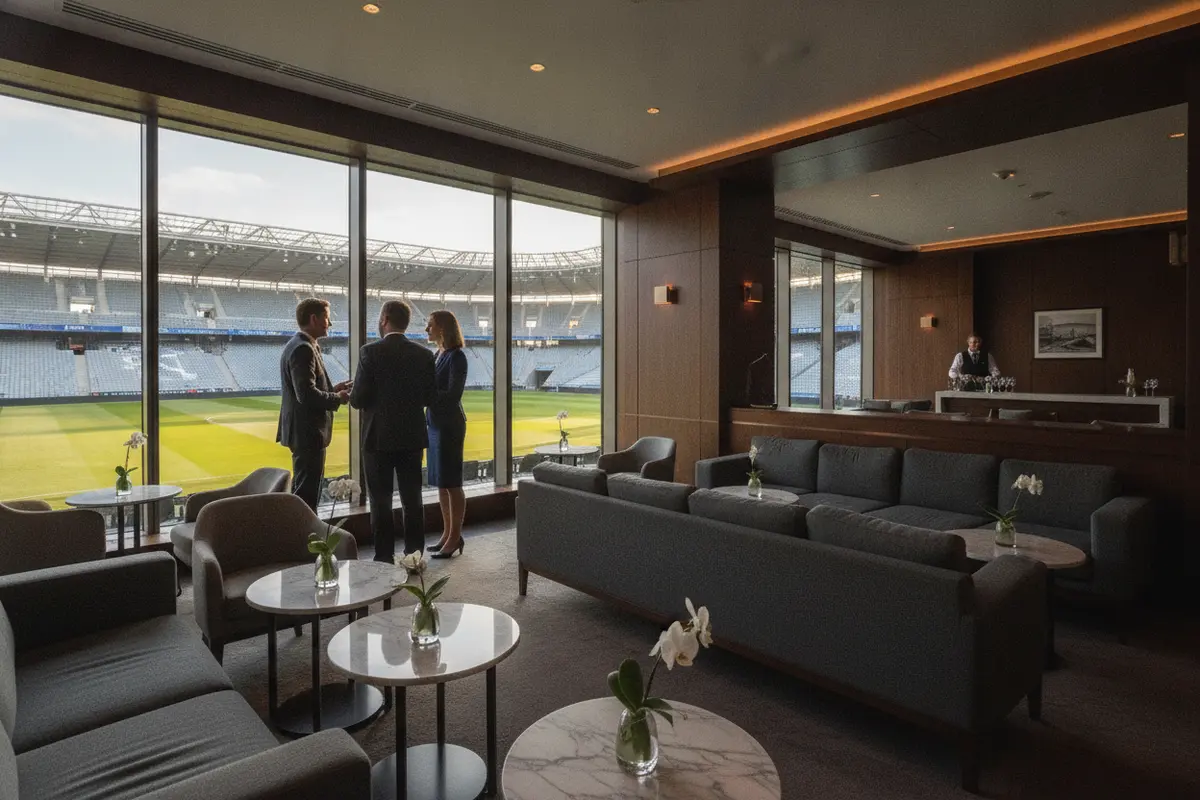
Confirm the distinction between event admission and hospitality access. Ask what credential or ticket each guest receives, when and how it is delivered, and what instructions accompany it. Ask what support is available if a guest has a problem at entry. Do not rely on a verbal assurance that everything will be handled; request the relevant process in writing so that you can communicate it accurately.
| What to compare | Questions to ask | What to confirm in writing |
|---|---|---|
| Match and venue | Is the match, date, venue, and kickoff time confirmed? | Current event details and any conditions that could change them |
| Admission | What seating category or location is included, and when is it assigned? | Ticket or credential type, delivery method, and timing |
| Hospitality | Which lounge, dining, or hosted elements are included, and during what hours? | Named inclusions, schedule, and any restrictions |
| Group experience | Can guests be seated or hosted together? Is the space shared? | Group size, seating arrangements, and known limits |
| Travel and support | Are lodging, transfers, or on-site assistance part of this proposal? | Included services, exclusions, contact point, and operating times |
| Commercial terms | What is the payment schedule, cancellation policy, and availability status? | Price basis, deadlines, refund or change terms, and any additional charges |
Comparing the same categories across proposals is more useful than comparing package names. The table is a working checklist, not a promise that any particular package includes every item. Mark each answer as confirmed, pending, or not included. If an item is central to your decision and remains pending, ask what happens if it cannot be delivered as described.
What should you verify about service, schedule, and logistics?
A strong event plan makes the guest journey understandable. Ask who will send the final itinerary, when it will arrive, and who guests can contact for event-day questions. Find out whether the point of contact is the same for the buyer and for attendees. For a hosted group, one clear communication channel reduces confusion and keeps the organizer from having to interpret incomplete instructions.
Map the important transitions: arrival in the city, check-in, travel to the venue, hospitality access, movement to seats, and departure afterward. You are not trying to plan every minute. You are checking whether the handoffs are clear and whether the proposed timing gives guests reasonable margin. Ask which transfers are arranged, if any, and which movements guests manage themselves. Confirm pickup locations and timings rather than assuming transport is part of a hospitality package.
Accommodation should be evaluated by its role in the itinerary, not by a label alone. If lodging is included, ask for the property or a clear standard, the room basis, check-in and check-out dates, and how the hotel relates to the event schedule. If lodging is separate, decide whether you want to book it independently or ask for broader coordination. For background on assessing an upscale stay, see this guide to choosing a luxury hotel; the package proposal still needs to state its own actual arrangements.
Accessibility and practical needs deserve direct, discreet questions. Ask how to raise mobility, dietary, or other relevant requirements, who can confirm whether a venue or hospitality area can accommodate them, and by what date that confirmation is needed. Do not infer accessibility from a general description or assume an accommodation is guaranteed until it has been checked. Provide only the information necessary to assess the request and follow the provider’s process for sharing it.
When considering a provider, look for clarity and continuity. Is there a named person who understands the purpose of the trip? Can that person explain what is confirmed versus pending? Are questions answered in a way you can pass on to guests? The company background and its description of personal service provide context about the team approach, but your decision should rest on the scope and commitments in your own written proposal.
For a corporate group, agree who owns each task. The buyer might manage guest invitations while the provider coordinates confirmed event elements. Someone may need to gather arrival details, dietary requests, and emergency contacts through appropriate internal processes. Put ownership and deadlines beside each task. This is not extra bureaucracy; it prevents assumptions from surfacing when guests are already traveling.
How do you assess value without comparing labels alone?
Compare proposals on a like-for-like basis. Begin with the total price for the number of guests you expect, then separate the event admission, hospitality, accommodations, travel, and any optional services. Ask whether the quoted amount is per person or for the group, what currency applies, when payment is due, and whether taxes or fees are additional. A lower headline figure may exclude elements that matter to your group, while a higher one may include services you do not need.
Do not compare one confirmed itinerary with another that is still a concept. Record which elements are guaranteed, which depend on availability, and which are optional. Ask whether substitutions require your approval and what comparable alternative would be offered if an element changes. Be especially clear about what happens if the match schedule changes, a guest cancels, or the group size shifts.
Terms deserve the same attention as inclusions. Read the payment schedule, cancellation and change provisions, name-substitution rules, ticket delivery terms, and any deadline to provide guest details. If the proposal refers to separate supplier terms, request those terms before deciding. Keep the final accepted scope, itinerary, and terms together so that the person managing the trip can refer to one reliable record.
Value also depends on the effort required from your team. A proposal with a clear itinerary and defined support can reduce coordination work, while a less expensive option may leave more tasks with the host. Estimate the time needed to arrange lodging, transfers, guest communications, and event-day updates. You are not assigning an arbitrary dollar value to convenience; you are making the tradeoff visible alongside the direct price.
Use proof carefully. Photos, testimonials, and broad service descriptions can help you understand a provider’s approach, but they do not confirm the details of your specific package. For example, you can review client testimonials for general context, then ask for written answers about the match and dates you are considering. Seek a proposal that makes it easy to tell exactly what your guests will receive.
Discuss your guest list and event priorities with the team
What is a practical process for choosing an option?
Use a short, repeatable process so that the decision stays focused on your requirements rather than the most polished sales language.
- Write the hosting brief. State the purpose, likely group size, preferred match or timing, guest profile, and the result you want the event to create.
- Identify must-haves and preferences. Separate essential requirements, such as a workable schedule or confirmed group seating, from desirable extras that could vary.
- Request comparable proposals. Send the same brief to each provider and ask them to identify confirmed elements, pending availability, exclusions, and deadlines.
- Check access and itinerary. Review the match information, seating or ticket category, hospitality schedule, arrival plan, and the handoffs between each stage.
- Review price and terms together. Compare total cost on the same guest-count basis, then read payment, cancellation, substitution, and change terms.
- Resolve open items before committing. Ask for written answers on any must-have that is still pending. Decide whether the remaining uncertainty is acceptable.
- Prepare a guest-ready plan. Once details are confirmed, share a concise itinerary, arrival instructions, contact information, and any requirements guests need to know.
Keep a simple comparison document with one line per question and one column per proposal. The labels “confirmed,” “pending,” and “not included” help avoid false equivalence. If a provider cannot yet confirm a detail, record the date when you expect an answer and the decision you will make if it remains unresolved. That turns uncertainty into a manageable part of the process.
When you are ready to look at event possibilities and the scope of a tailored experience, browse the event experience listings and bring your specific match, guest count, and priorities to the conversation. Superior Executive Services describes its role as creating end-to-end experiences rather than simply selling tickets. Ask what that means for the particular event under consideration, and have the response reflected in the proposal.
For a useful first enquiry, include the match or date you have in mind, approximate group size, whether the event is for clients or employees, and the parts of the experience you want help coordinating. Mention any timing constraints and identify which details are essential. You can request a conversation through the contact page; a clear brief makes it easier to determine what needs confirmation next.
Proposals may not all use the same names for access tiers or amenities. Ask the provider to translate each label into practical details: where guests may go, what is scheduled, what is included in the price, and who handles questions. If the answer is still abstract, request a revised scope before using the offer to invite guests or secure internal approval.
Request a tailored Champions League hospitality discussion
Frequently Asked Questions
What is usually meant by Champions League hospitality?
The term can refer to a combination of match admission and hosted or lounge elements, but exact inclusions vary by offer. Ask for the seat or ticket category, hospitality location and hours, food or beverage details, and any access restrictions in writing. Confirm whether lodging, transportation, and other trip services are included or separate.
Does a hospitality package automatically include hotel and transfers?
No. Do not assume lodging or transportation is included because a proposal describes a complete or premium experience. Check the written itinerary and price breakdown for each service. If an element is not listed, ask whether it can be arranged and how its cost and terms would be presented.
What should a company ask before inviting clients?
Confirm the match details, guest capacity, ticket delivery plan, schedule, hospitality inclusions, total price, and change or cancellation terms. Ask who will be the point of contact and what instructions guests will receive. If an essential detail is pending, decide whether to wait for confirmation before sending invitations.
How can I compare two packages fairly?
Use the same guest count and the same checklist for both. Compare confirmed access, hospitality hours, seating or group arrangements, trip logistics, support, price basis, exclusions, and terms. Mark pending items clearly instead of treating them as included, then ask each provider to resolve your most important open questions.
When should I request a proposal?
Start when you can describe your likely date or match, group size, and purpose, and allow time to verify availability and coordinate guest logistics. Ask the provider which details can be confirmed now and what information or deadlines are needed from you. Do not treat an enquiry as a reservation until the offer and next steps are clear.
The right choice is the proposal whose confirmed access, hospitality, schedule, and terms match the needs of your guests, with any remaining uncertainty made explicit before you commit.